


Many organisations have come to realise (often through experience) that their CRM is not effectively enabling revenue growth. Instead, it has evolved into a complex, resource-intensive system with low internal adoption.
According to a recent study conducted among 500 sales leaders, 81% indicated they are likely to replace their CRM within the next year. The primary drivers cited include unintuitive user interfaces, ineffective reporting capabilities, and a growing perception that the total cost outweighs the value delivered.
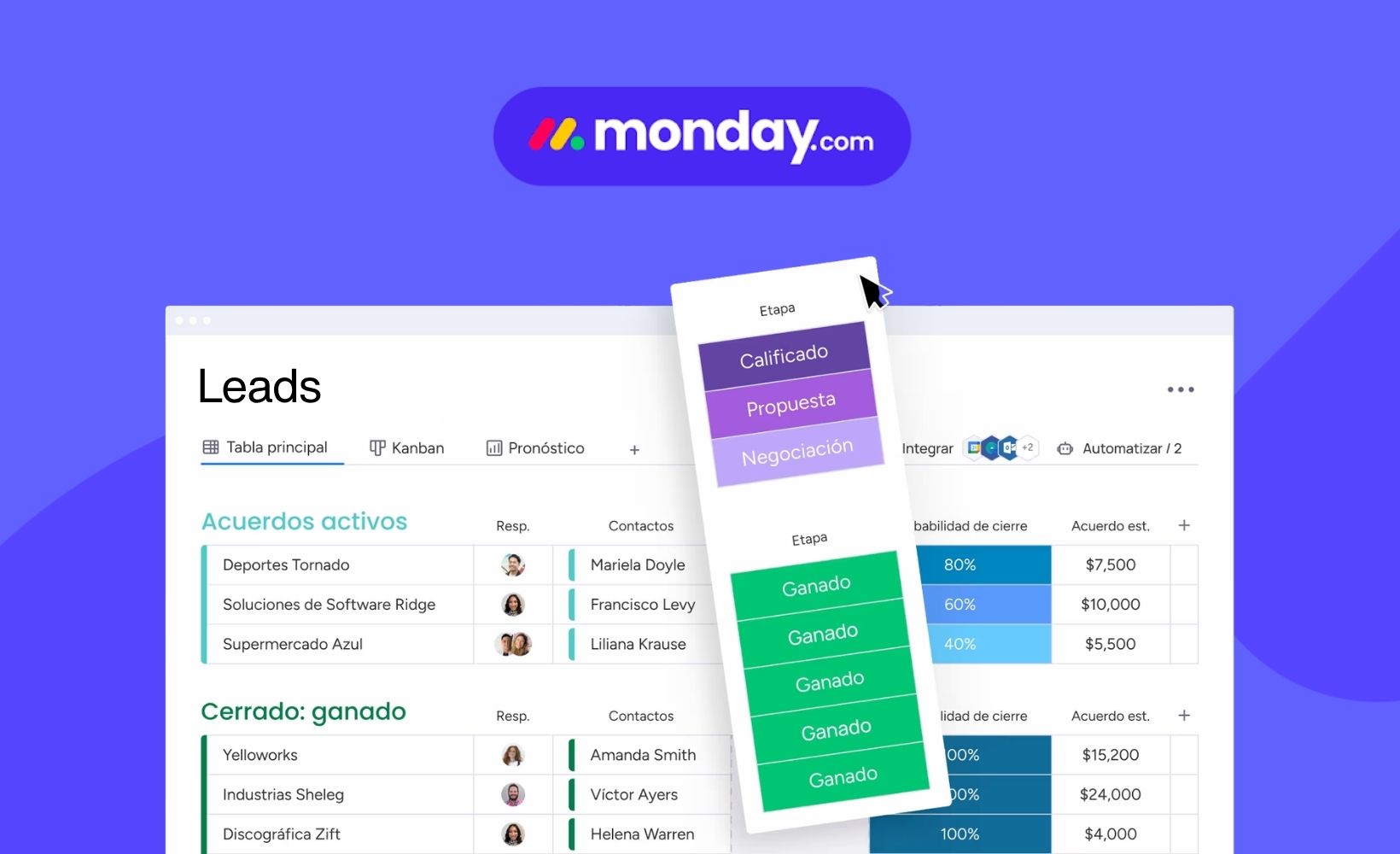
Within this context, monday CRM (one of the specialised solutions within the monday.com ecosystem) introduces a fundamentally different approach. Its objective is clear: to deliver a visual, flexible CRM that not only supports operations but actively enhances decision-making. In this article, we explore how it achieves this.
What monday CRM is and why it stands apart
Monday.com was originally developed as a versatile platform for process management and collaboration. Building on this foundation, the company has introduced a range of specialised products, licensed independently from its core platform, monday CRM is one of these dedicated solutions.
monday CRM is a visual, no-code, and collaborative platform designed to unify marketing, sales, and post-sales operations within a single, cohesive workflow. It also embeds automation and artificial intelligence natively within the system, enabling organisations to reduce manual effort and accelerate their commercial cycles.
Its differentiation lies not only in functionality, but in delivery: an intuitive, highly customisable visual experience engineered to drive real user adoption. The platform has been purpose-built to address the systemic limitations of traditional CRM systems, ensuring it does not become yet another underutilised tool.
Common challenges with traditional CRM systems
Despite robust feature sets, many CRM implementations fall short due to structural inefficiencies.
Key industry challenges include:
- Fragmentation across sales, marketing, and post-sales teams.
- Lengthy and costly implementation cycles.
- Ongoing dependence on technical specialists for system changes.
- Low adoption rates, leading to incomplete data and unreliable reporting.
- Excessive time spent on administrative tasks such as data entry, manual updates, and reporting.
Monday CRM is specifically designed to eliminate these sources of friction.
What sets monday CRM apart
Accelerated time-to-value
One of the platform’s most significant advantages is its rapid deployment and adoption. Unlike traditional CRM implementations that may take months, monday CRM enables organisations to operationalise structured processes within days or weeks.
Its intuitive, visual interface promotes immediate engagement. High adoption leads to higher-quality data, which in turn drives more informed decision-making.
True no-code flexibility
monday CRM empowers business users to configure and evolve the platform independently, without ongoing reliance on developers or external consultants.
Core elements (including fields, automations, statuses, approval workflows, and dashboards) can be customised using visual logic and simple rule-based configurations. This represents a substantial advantage over more rigid CRM systems, where even minor changes can require dedicated technical projects.
End-to-end customer visibility
A persistent challenge in many CRM environments is the disconnect between sales and post-sales functions. monday CRM addresses this by integrating pipeline management, onboarding, project delivery, and customer success within a unified environment.
This is enabled through native integration with the broader monday.com ecosystem. As a result, transitions from closed deals to delivery and account management are seamless and instantaneous.
This unified structure eliminates context loss, reduces reliance on email handovers, and removes the need for parallel tracking systems such as spreadsheets. All customer data from initial lead to renewal or expansion is centralised within a single platform.
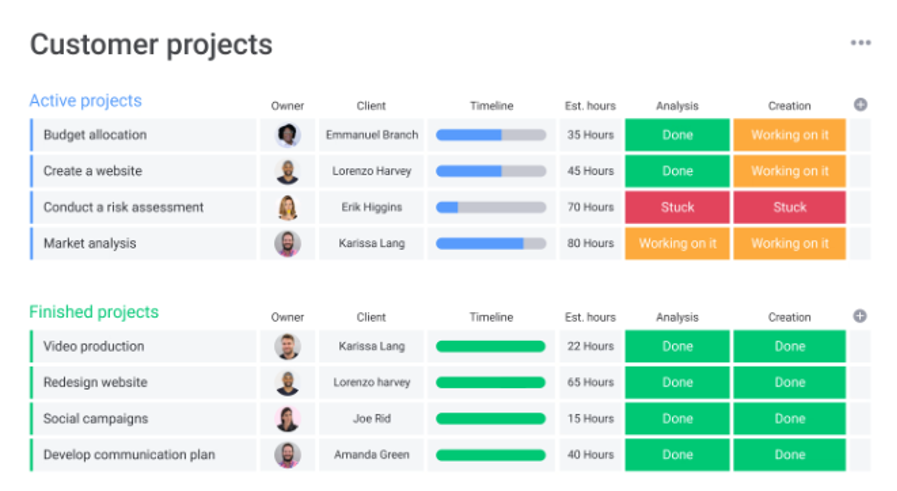
Additionally, configurable dashboards provide clear visibility into pipeline performance, forecasting, sales activity, and account health, without requiring technical expertise.
Improved business performance
Enhanced pipeline visibility, intelligent alerts, opportunity prioritisation, and built-in upsell and cross-sell identification directly contribute to increased deal velocity and revenue growth.
By consolidating tools, reducing administrative overhead, and minimising dependence on specialised roles, organisations benefit from a lower total cost of ownership compared to more complex CRM ecosystems.
Centralised data, improved handoff traceability, and higher forecast accuracy collectively reduce operational risk and support more confident decision-making.
Proven impact across organisations
Real-world use cases further validate these outcomes.
KC Petroleum achieved an 18x return on investment while saving over 25 hours of administrative work per month, following full organisational adoption in just one month.
Velv reduced manual sales follow-up effort by 60% and decreased unnecessary email volume by 80%.
Black Mountain increased conversion rates by 15% while also saving more than 10 hours in administrative tasks.
A key differentiator: AI embedded at the core of the workflow
Perhaps the most defining characteristic of monday CRM is its native integration of artificial intelligence.
Rather than being deployed as an external add-on or isolated module, AI is embedded directly into the operational workflow.
This enables seamless, context-aware functionality across the platform.
AI Notetaker: from meetings to execution
The AI Notetaker can automatically join meetings, generate transcripts, summarise discussions, identify decisions and ownership, and synchronise all outputs directly into monday CRM boards.
This transforms meeting data into structured, actionable workflows, reducing information loss, minimising redundant meetings, and ensuring execution clarity.
AI-powered pipeline management
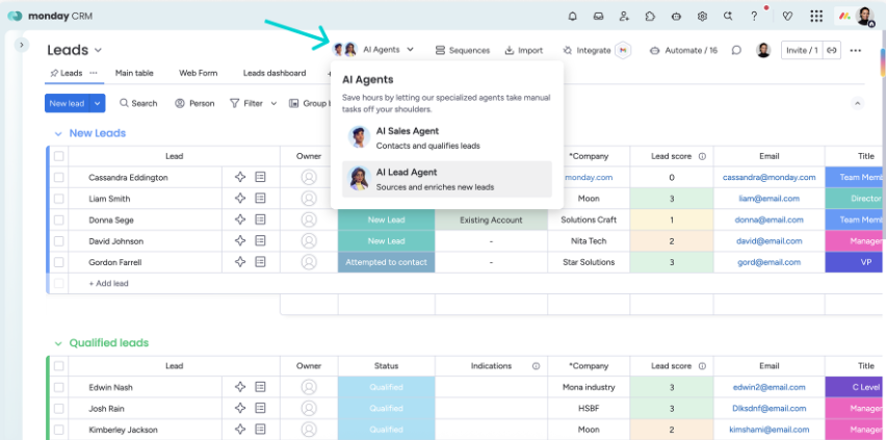
Monday CRM incorporates intelligent agents such as Lead Agent and SDR Agent.
Lead Agent can define or refine ideal customer profiles (ICPs), identify and enrich leads, and automatically populate the CRM, significantly reducing manual prospecting efforts.
SDR Agent automates lead qualification, logs and transcribes conversations, and extracts actionable insights from interactions.
These capabilities enable organisations to scale revenue operations without proportionally increasing headcount, as AI assumes repetitive, time-intensive tasks.
AI-driven insights and deal intelligence
Features such as AI Deal Insights continuously analyse open opportunities, detect positive or negative signals, prioritise actions, and recommend next steps.
Monday CRM: a different CRM
As demonstrated, monday CRM represents a shift towards a more autonomous, intelligence-driven CRM model where AI, automation, and proactive insights actively support commercial decision-making.
While many established CRM platforms remain competitive, monday CRM differentiates itself through:
- Lower total cost of ownership
- Faster and more agile implementation
- No-code configurability
- Greater flexibility and seamless integration within a collaborative ecosystem
It is particularly well suited to growing organisations with 100 to 1,000 employees that require speed, scalability, and cross-functional alignment and that seek a CRM designed to actively support their commercial teams, rather than simply serve as a data repository.
If you would like to assess how monday CRM can be aligned with your sales processes and how Holistic Data Solutions can support you as a certified monday.com partner in its implementation and optimisation, we invite you to connect with our team. We will be pleased to help you transform your CRM into a strategic growth engine.
Related Articles

In a context like the current one where financial instability and market volatility are so present, it is normal that [...]

Operational management in the retail sector is complex for many reasons: the number of factors to consider, changes in trends [...]

We are living in an era of digital revolution: artificial intelligence, metaverse, digital twins, process automation... These and many other [...]